A sewer line's lifespan depends almost entirely on its material — and New Jersey housing spans all of them. As broad industry ranges: vitrified clay can serve 50-100+ years but is root-prone at every joint; cast iron typically runs 50-75 years before scale and corrosion choke it; Orangeburg was built for 50 and frequently fails at 30-40; modern PVC is engineered for a century or more and hasn't been in the ground long enough to prove it wrong. The material is set by your home's construction era, which is why the same street often shares the same countdown.
Most pre-1940s New Jersey laterals are vitrified clay — genuinely durable pipe with one flaw: a joint every few feet, and every joint is a door for tree roots. Clay rarely dies of old age; it dies of root intrusion and joint offsets. Our tree-root guide covers that battle in full.
Cast iron doesn't leak at joints the way clay does — it corrodes from the inside. Rust scale builds until a 4-inch pipe flows like a 2-inch, then the bottom channel rusts through where water sits. Whether yours should be descaled, lined, or replaced is its own decision tree — we wrote it up in this guide.
If your home drew Orangeburg in the postwar material lottery, the lifespan tables above don't apply — it deforms and collapses on its own schedule. We covered how to tell if you have it in detail; the one-line version is that a camera settles it and nothing else does.
Mature street trees, shifting sandy soil at the shore, clay soils that swell and settle inland, flood events that surcharge the ground, and construction traffic above the run. Two identical pipes in Montclair and Toms River age differently because the ground around them behaves differently.
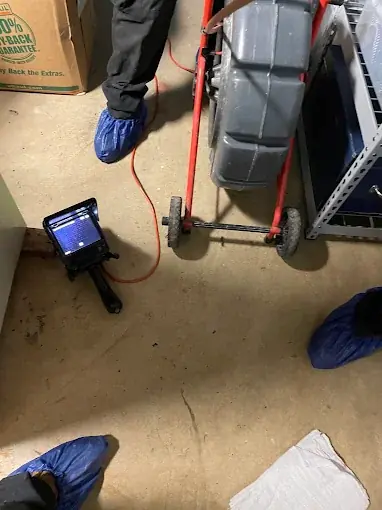
Age is a probability; condition is a fact. A recorded camera inspection converts one into the other in about half an hour — every joint, every foot, with distance markers on anything worth watching. If your home is past 50 and the line has never been looked at, that's the whole argument.
Recorded HD video • Exact locating • Flat-rate quote before we roll
Pay only when your clog's gone. 30–90 minute response anywhere in New Jersey.
Thanks! Our team will update you within the hour. For emergencies call 973-355-0890 now.