Puddles where drains should be? We clear clogged yard drains, area drains, downspout lines and dry wells across New Jersey — jetted clean before the next storm finds your basement. Call 973-355-0890.
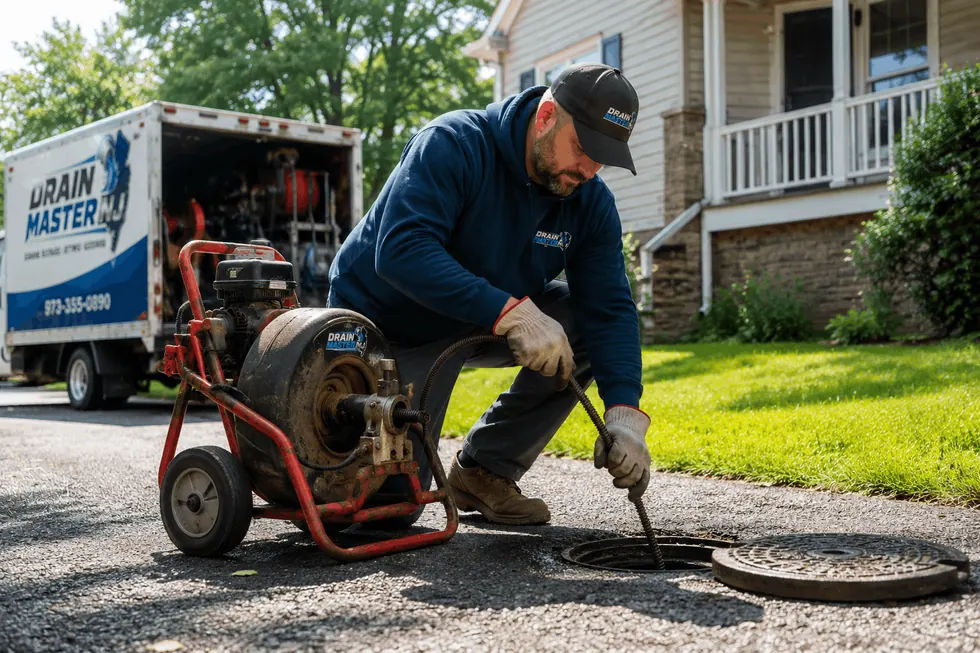
Most New Jersey properties have more buried drainage than their owners know: area drains collecting lawn runoff, downspout lines carrying roof water away from the foundation, dry wells and seepage pits absorbing it underground, and connector piping tying it all together. It works invisibly — until it doesn't. Because these lines carry debris-laden stormwater through small-diameter corrugated or PVC pipe, they clog faster than any indoor drain, and the first symptom is usually a flooded low spot, a waterfall over a gutter, or water where you least want it: against the foundation.
Outdoor lines respond best to hydro jetting: pressurized water scours leaves, silt and sludge out of the full pipe run and flushes it downstream to daylight or the collection point — something cables can't do in debris-packed corrugated pipe. We clear grates and catch points by hand, jet each run, cut intruding roots, and camera-verify problem lines to find bellies, crushed sections and separations. If a section is collapsed, jetting won't fake it back to life; we'll show you the footage and quote the repair honestly.
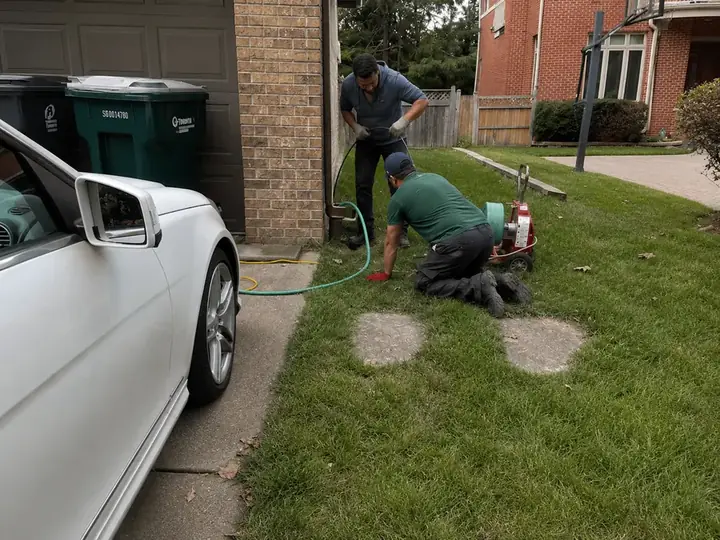
The buried lines carrying roof water away from the house are the most consequential drains on the property — when they clog, hundreds of gallons per storm discharge directly against your foundation. The signs: gutters overflowing at the downspout, water bubbling from the downspout boot, damp basement walls after rain, and erosion trenching below gutter runs. If your basement gets damp in storms, these lines are suspect number one; clearing them is dramatically cheaper than waterproofing. Related: standing water in basements.
Where storm water can't run to the street, it runs to a dry well — and dry wells silt up. A pit that once swallowed a storm now fills in minutes and backs water up every connected line. We jet the feeder lines, assess whether the well itself has capacity left, and give you real options when it doesn't. Sump pump discharge lines get the same treatment: a frozen or clogged discharge line defeats the pump exactly when you need it, and we clear them before the season that tests them.
Outdoor drain work is calendar work in New Jersey. Fall cleaning (after leaf drop) clears the year's debris before winter locks it in ice. Spring cleaning readies lines for thaw and nor'easter season. Between them, keep grates raked and downspout screens clear. Properties with heavy tree cover do well on a twice-yearly maintenance schedule — the cost of prevention being a rounding error against one finished-basement flood.
From single-family yards to HOA common areas, retail parking islands and municipal-adjacent systems (see also storm drain cleaning and catch basin cleaning), we service outdoor drainage across all 21 counties — with the jetting capacity to handle long runs and the cameras to prove the line is actually clean.
Outdoor drain service is quoted flat by system scope: a single clogged area drain and its run sits at standard service rates; a whole-property cleaning — every grate, downspout line and the dry well feeders — is priced as one package that costs far less than the sum of separate calls. Camera work on problem lines is a modest add-on that frequently saves its cost by proving whether a line needs repair or just needed jetting. For perspective on value: a full outdoor cleaning typically costs less than one water-damage insurance deductible, and immeasurably less than the finished-basement flood it prevents. Seasonal maintenance pricing drops the per-visit cost further.
New Jersey's outdoor drainage challenges are regional, and we've worked all of them: oak and maple leaf loads that bury North Jersey grates every October, sandy shore soils that migrate into pipes and silt dry wells, clay-heavy central counties where runoff moves fast and hard, and freeze-thaw cycles that heave and crack neglected lines statewide. That context shapes real recommendations — which properties genuinely need twice-yearly service, where root barriers earn their cost, when a struggling dry well can be revived versus replaced. Local judgment, backed by jetting capacity sized for long outdoor runs, is the whole service.
Before each storm season, walk your property with this list. Every grate visible and clear of leaves, mulch and grass creep. Downspout connections intact — no gaps where roof water escapes at the foundation. Discharge points and pop-up emitters open, not lawn-buried. Dry well access located and its lid sound. Low spots that puddled last year noted — they're telling you where a line struggles. During the first hard rain, watch: gutters overflowing at one downspout, a grate ponding while others swallow, or a channel backing up all identify the exact line that needs service, cheaply, before the nor'easter that would have found it for you. Ten minutes of looking, twice a year, is the best free drainage maintenance there is — and when the walk finds something, we're one call away.
Outdoor drainage service covers every corner of the state, and geography drives the work. Heavily treed North Jersey — Bergen, Morris, Essex, Passaic, Sussex — buries grates in leaves each fall and feeds roots into every corrugated joint. Central Jersey's clay-rich Middlesex, Somerset, Mercer and Monmouth push fast, hard runoff at yard systems. The shore — Ocean, Monmouth, Atlantic, Cape May — contends with sand migration and dry wells in high water tables, while South Jersey's Camden, Burlington and Gloucester mix all of the above. Twenty-one counties of different drainage problems; one company equipped for each of them. Popular service areas:
Hydro jetting — pressurized water scours leaves, silt and roots out of the full run and flushes them out of the system. Cables just poke holes in packed debris; jetting actually empties the pipe.
Either the line from that drain is clogged or a section has settled, crushed or separated. We jet first, and camera the line if flow doesn't fully return, so you learn which problem you actually have.
Yes — and if your basement dampens after storms, those lines should be the first suspects. Clearing them is far cheaper than waterproofing a foundation.
Silted dry wells lose absorption capacity. We jet the feeders, assess remaining capacity, and quote honest options if the well itself is spent.
Once or twice a year — after leaf drop and before spring storms — for most NJ properties, more often under heavy tree cover. Maintenance scheduling makes it automatic.
Yes — jetting can't revive collapsed pipe, so when the camera shows a crushed section we quote a spot repair with proper pipe, flat-rate, footage included.
Flat-rate pricing • 30–90 minute response • Pay only when your clog's gone
Pay only when your clog's gone. 30–90 minute response anywhere in New Jersey.
Thanks! Our team will update you within the hour. For emergencies call 973-355-0890 now.